Structural Drying & Dehumidification in Leander, TX
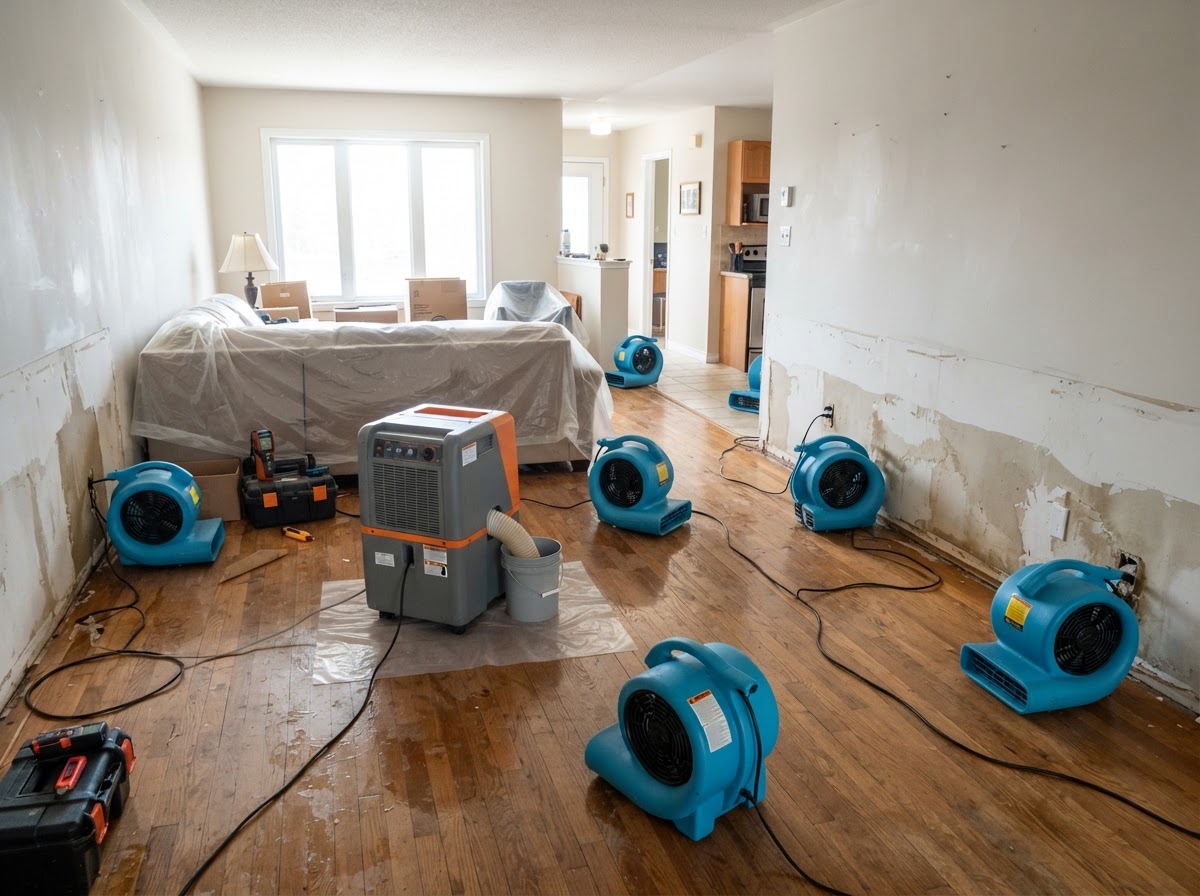
Structural drying and dehumidification in Leander, TX is the process of removing bound moisture from building materials after standing water has been extracted. Removing visible water and drying materials are different stages of restoration: extraction pulls pooled water from surfaces, while structural drying evaporates and captures the moisture that has soaked into drywall, wood, subflooring, insulation, and framing. Leander Water Damage Restoration uses commercial air movers and dehumidifiers, guided by moisture meters and thermal imaging, to dry affected materials to target levels. Because water migrates into concealed areas, drying is not complete until moisture readings confirm that materials behind walls and beneath flooring are dry — not just when surfaces feel dry to the touch. For homes and businesses in Leander and the surrounding North Austin area, structural drying helps address hidden moisture after water damage. If your property needs drying, call 737-379-0924 to discuss the process.
What Structural Drying Includes in Leander
Structural drying is the process of removing moisture that has absorbed into building materials, and it is a distinct stage from water extraction. Removing visible water — extraction — pulls pooled water from surfaces, but it does not dry the materials that have absorbed moisture. Structural drying is governed by psychrometrics — the science of moist air properties — which determines how readily moisture evaporates from wet materials into the surrounding air. Air movers accelerate evaporation by creating a vapor pressure differential between the wet material surface and the air above it, while dehumidifiers lower the air's specific humidity, measured in grains of moisture per pound of dry air (GPP), so that evaporated moisture is captured rather than reabsorbed into materials. Without dehumidification, evaporated moisture raises the air's relative humidity and dew point until it recondenses and reabsorbs into drywall, wood, and other materials, undoing the drying progress. Low-grain refrigerant (LGR) dehumidifiers are engineered to pull indoor air down to a very low GPP, sustaining the vapor pressure deficit that drives continued evaporation from deeply saturated framing, subflooring, and drywall. The drying process is guided by moisture assessment: moisture meters and thermal imaging map which materials are wet and how wet they are, so equipment is placed where moisture actually is rather than only where water appears on the surface. Materials that may retain moisture after water damage include drywall, wood framing, subflooring, flooring systems, insulation, cabinetry, wall cavities, and ceiling assemblies. These materials absorb water at different rates and release it at different rates, so drying is monitored throughout with ongoing moisture and psychrometric readings that track GPP, relative humidity, and temperature together. This page does not state that every affected material can be saved — some materials, such as heavily saturated drywall, contaminated porous materials, or materials whose structural integrity has been compromised, may need to be removed rather than dried. The drying process determines which materials can be dried to target levels and which are too damaged to retain. Because water migrates into concealed areas like wall cavities and beneath flooring, drying is not complete until moisture readings confirm those concealed materials have reached target levels — not just when surfaces feel dry.
Materials That Retain Moisture After Water Damage
After water damage, several building materials retain moisture that structural drying must address. Drywall absorbs water readily through its paper facing and gypsum core, wicking moisture upward from the floor; lightly damp drywall can often be dried, while heavily saturated drywall may lose structural integrity and need removal. Wood framing — studs, joists, and trusses — absorbs moisture and can swell, warp, or weaken, though solid framing can often be dried if moisture is addressed before secondary deterioration occurs. Subflooring, including plywood and oriented strand board, absorbs water from above and below and can delaminate or swell; drying addresses both surfaces, and damaged subflooring may need replacement. Flooring systems — hardwood, laminate, vinyl plank, and tile assemblies — each respond differently to moisture, with hardwood cupping or crowning, laminate swelling at edges, and water traveling beneath vinyl and tile into the subfloor. Insulation in wall cavities and attics absorbs moisture and holds it against framing and drywall; some insulation can be dried, while wet insulation in enclosed cavities may need removal to allow airflow. Cabinetry and vanities trap moisture against walls and subflooring, requiring attention to the concealed areas behind and beneath them. Wall cavities collect water that has migrated behind baseboards, holding moisture against drywall, insulation, and framing that surface drying cannot reach. Warning signs that materials retain moisture include soft or crumbling drywall, swollen or warped wood, cupped flooring, damp odors, recurring stains, and materials that feel cool or damp to the touch. This page does not state that every affected material can be saved — moisture readings and material condition determine what can be dried versus what must be removed. If materials appear structurally unstable, do not enter the affected area.
How Structural Drying Works in Leander
Structural drying follows a structured sequence guided by moisture readings throughout. Procedures vary based on the materials and extent, but a typical approach includes:
- 1
Moisture Assessment
Moisture meters and thermal imaging map which materials are wet, how wet they are, and where moisture has migrated — including inside wall cavities and beneath flooring. This moisture map guides where drying equipment is placed and establishes baseline readings.
- 2
Air Movement
Air movers are positioned to direct high-velocity airflow across wet surfaces, accelerating the evaporation of bound moisture from drywall, framing, subflooring, and flooring. Placement is based on the moisture map and adjusted as materials dry.
- 3
Dehumidification
Low-grain refrigerant (LGR) dehumidifiers pull moisture from the air, lowering its specific humidity measured in grains per pound of dry air (GPP). By reducing the air's GPP and dew point below the moisture level of the wet materials, dehumidifiers maintain the vapor pressure deficit that keeps moisture moving out of materials rather than reabsorbing into them. Without dehumidification, evaporated moisture raises relative humidity until the air can no longer hold it and it recondenses on surfaces. Dehumidifiers run continuously throughout drying.
- 4
Evaporation
The combination of high-velocity air movement and low-GPP dehumidified air drives evaporation — moving moisture from wet materials into the air and then into the dehumidifier. The greater the vapor pressure differential between the wet material surface and the surrounding air, the faster moisture evaporates. This process pulls deeply embedded moisture out of wood, drywall, and framing over time.
- 5
Psychrometric Monitoring
Throughout drying, moisture meter readings are paired with psychrometric measurements — indoor GPP, relative humidity, and temperature — to confirm the environment is actually pulling moisture from materials rather than approaching equilibrium. Equipment placement and dehumidifier capacity are adjusted based on these readings. Monitoring ensures that concealed materials — inside walls and beneath floors — are actually drying, not just surfaces.
- 6
Drying Goals
Drying continues until materials reach target moisture levels, established from baseline readings and the equilibrium moisture content appropriate to each material. The indoor environment is maintained at a GPP and relative humidity that keeps driving evaporation until those targets are met. Equipment is removed once readings confirm all affected materials — including concealed areas — are dry. The timeline varies and is not a fixed number.
Because drying depends on material type, saturation, the psychrometric conditions maintained indoors (GPP, relative humidity, temperature, and vapor pressure), air movement, water migration, access to concealed areas, and the extent of the loss, the timeline varies and no exact drying time can be guaranteed. Drying is complete only when moisture readings confirm all affected materials have reached target levels — not when the air feels dry or surfaces feel dry to the touch.
Why Professional Structural Drying Matters for Leander Properties
Professional structural drying matters because moisture that has absorbed into building materials does not leave on its own — it must be actively evaporated and captured, and concealed moisture behind walls and beneath flooring cannot be addressed by surface drying alone. Drying is governed by psychrometrics: the relationship between temperature, relative humidity, and specific humidity (grains per pound of dry air, or GPP) determines how readily moisture moves out of wet materials. Professional drying manipulates these conditions — using high-velocity air movement to create a vapor pressure differential at material surfaces and low-grain refrigerant (LGR) dehumidifiers to hold the air at a low GPP and dew point — so moisture continuously evaporates rather than recondensing. Without controlled air movement and dehumidification, trapped moisture increases the risk of secondary deterioration, odors, and microbial growth in drywall, framing, subflooring, and insulation. Without psychrometric and moisture monitoring, materials can appear dry on the surface while remaining wet inside, leading to ongoing damage after equipment is removed. Professional drying brings moisture meters, thermal imaging, air movers, and dehumidifiers together in a monitored process that tracks both moisture readings and indoor GPP until all affected materials — including concealed areas — reach target levels. For Leander properties near US-183, the 183A Toll Road, Crystal Falls Parkway, and Ronald Reagan Boulevard, structural drying focuses on verifying that building materials are actually dry, not just dry to the touch. Serving Leander and surrounding Williamson County and North Austin communities, the process is tailored to the materials and extent of each loss. Depending on the source of your water damage, these related services may also be relevant:
Structural Drying & Dehumidification FAQs for Leander, TX
Need Structural Drying in Leander?
If water damage has left moisture in your drywall, flooring, framing, or wall cavities, call to discuss moisture evaluation, professional air movement, dehumidification, and monitored structural drying.