
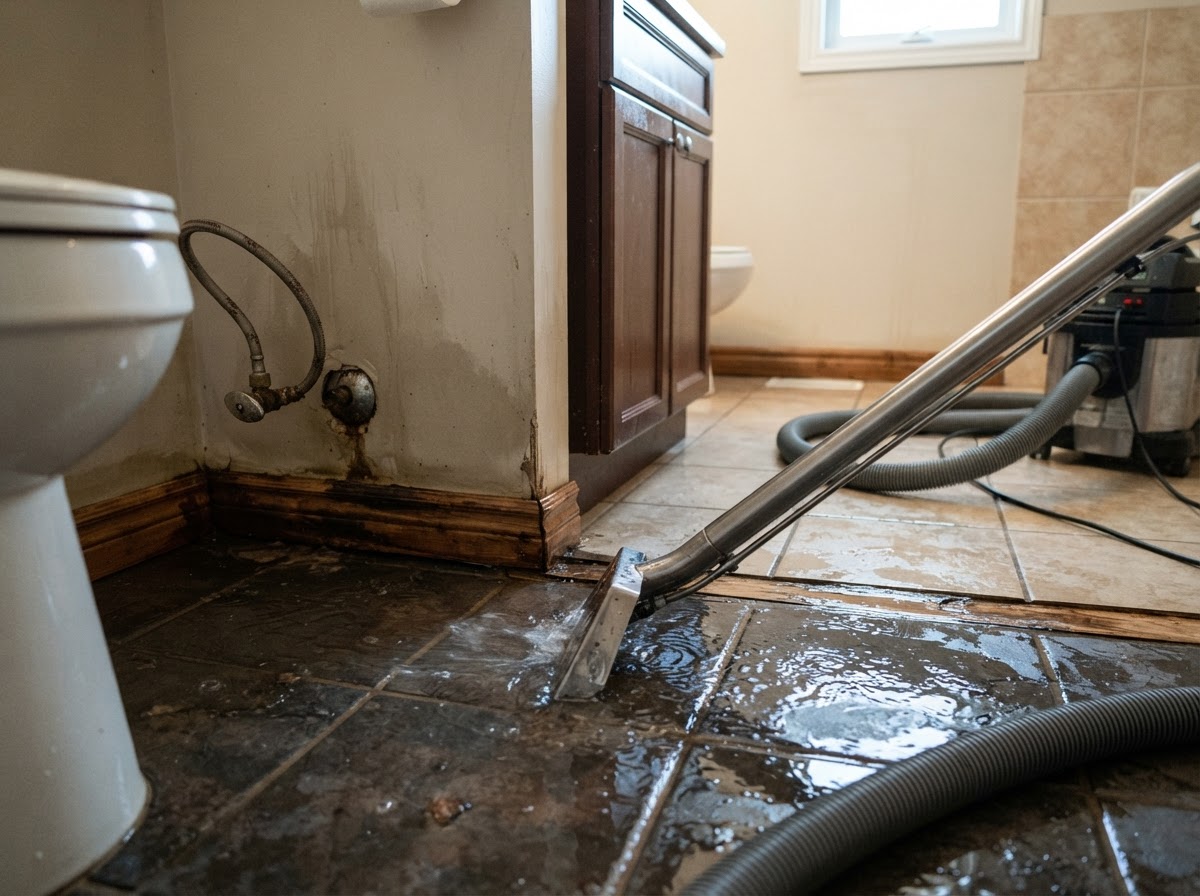
Supply Line Break & Water Line Leak Cleanup in Leander, TX
Supply line break and water line leak cleanup in Leander, TX addresses the water damage that results when a fixture supply line, appliance supply hose, or water line fails suddenly or develops a slow leak. Supply lines serve toilets, sinks, washing machines, refrigerators, dishwashers, and water heaters, and because they carry pressurized water, a break can release a substantial volume quickly across flooring, into walls, and beneath cabinets. Leander Water Damage Restoration does not repair supply lines or fixtures. Once the failed line has been shut off or repaired by the appropriate party, restoration focuses on extracting water, evaluating moisture migration, and drying affected materials. Because supply line water often travels beneath flooring and into adjacent rooms before it is visible, moisture detection is central to the process. If a supply line break or water line leak has caused water damage in your Leander property, call 737-379-0924 to discuss cleanup and drying.
What Happens When a Supply Line Breaks in a Leander Property?
A supply line carries pressurized water to a fixture or appliance, and when that line or its connection fails, water releases continuously until the supply is shut off. Because supply lines serve fixtures throughout a property — toilets, sinks, washing machines, refrigerators, dishwashers, and water heaters — a break can occur in almost any room and release water across flooring, into walls, beneath cabinets, and into adjacent spaces. A sudden break floods the area quickly, while a slow leak at a connection can persist for some time, allowing water to saturate the subfloor and wall cavity before it becomes visible. The water from a supply line break does not stay confined to the fixture area. It travels beneath flooring, wicks into baseboards and lower drywall, reaches the subfloor, and can move into adjacent rooms along the flooring edge. When the fixture is on an upper level, water can penetrate the floor assembly and reach the ceiling of the room below. This is why supply line break cleanup focuses on moisture evaluation as much as on water removal. After the failed line has been shut off or repaired, professional restoration extracts standing water, maps how far moisture has migrated, and dries affected materials. The goal is to address both the visible water and the concealed moisture that traveled beyond the fixture area.
Sudden vs Slow Supply Line Leaks and Affected Areas
Supply line failures fall into two broad patterns, and each affects the cleanup approach differently. A sudden break, where a line separates or a connection fails completely, releases a large volume of water quickly. The damage is usually obvious immediately, with standing water across the floor and visible spread into adjacent areas. A slow leak, where a connection drips or a line develops a pinhole, releases water gradually and can persist for days or weeks. Slow leaks are deceptive because the water often travels beneath the fixture and into the subfloor or wall cavity before any visible sign appears, and by the time it is discovered, the concealed materials may already be saturated. Affected areas commonly include the flooring around the fixture, the subfloor beneath, baseboards and lower drywall on adjacent walls, cabinetry that contacts the floor, and the wall cavity behind the fixture. When the fixture is upstairs, the ceiling drywall and framing of the room below can also be affected. Warning signs that a slow supply line leak has spread include damp or warped flooring, swollen baseboards, discoloration on lower walls, water beneath cabinets, and a persistent musty odor. These signs can indicate concealed moisture and should be investigated with professional detection tools. The failed line itself should be shut off or repaired by the appropriate party before restoration begins.
Water Extraction and Drying After a Supply Line Break
After the failed line has been shut off or repaired, supply line break cleanup follows a structured sequence focused on removing water and drying moisture that has migrated beyond the fixture area. The specific steps vary with the fixture, materials, and extent of migration.
- 1
Evaluate the Water Source and Affected Areas
The fixture area and surrounding rooms are assessed to identify where water has reached flooring, baseboards, drywall, cabinets, and the subfloor. This evaluation establishes the scope of water damage before extraction begins.
- 2
Address Safety Concerns
Standing water near the fixture's electrical connection, nearby outlets, or a ceiling fixture below is evaluated for safety. The area is approached carefully, and unsafe conditions are avoided until safe.
- 3
Extract Standing Water
Commercial extraction equipment removes visible water from the flooring and around the fixture. Water that has reached beneath cabinets and into adjacent rooms is addressed where access allows.
- 4
Assess Moisture Migration
Moisture meters check the subfloor beneath the fixture, the lower wall sections, baseboards, cabinetry, and adjacent flooring. When the fixture is upstairs, the ceiling below is also checked. This step locates water that traveled beyond the visible area.
- 5
Dry Affected Materials
Air movers and dehumidifiers target the areas where moisture was detected. Equipment placement may focus on the subfloor, wall cavities, cabinet bases, and adjacent flooring where concealed water collected.
- 6
Monitor and Complete Cleanup
Moisture readings are tracked until affected materials reach an appropriate drying goal. Flooring, wall, and cabinet surfaces are addressed as part of final cleanup once drying is complete.
Drying time depends on the materials involved, saturation, airflow, humidity, and how far water migrated beneath flooring and into walls, so no fixed timeframe applies.
Why Professional Supply Line Cleanup Matters in Leander
Supply line breaks are deceptive because the fixture often hides the area where water first collects, and a slow leak can saturate concealed materials before any visible sign appears. Professional moisture evaluation reaches the subfloor, wall cavities, and cabinet bases that a homeowner cannot easily inspect, so drying equipment targets the actual affected area rather than only the visible floor. In Leander and the surrounding Williamson County area, properties with multiple fixture supply lines benefit from this thorough approach because moisture left beneath cabinets and inside walls continues to affect materials long after the floor appears dry. Related restoration services may apply depending on the fixture and how the water spread. The broader burst pipe and plumbing leak cleanup service covers the full category of plumbing-related water damage. For rapid removal of standing water, emergency water removal and extraction focuses on the extraction phase. Structural drying and dehumidification addresses moisture retained in subfloor and wall materials. When the supply line served a washing machine, washing machine overflow and laundry room water damage cleanup applies to that fixture-specific scenario.
Supply Line Break & Water Line Leak FAQs for Leander, TX
Need Supply Line Break Water Cleanup in Leander?
If a supply line break or water line leak has caused water damage in your Leander property, call to discuss water extraction, moisture evaluation, and structural drying of affected flooring, walls, and building materials.